



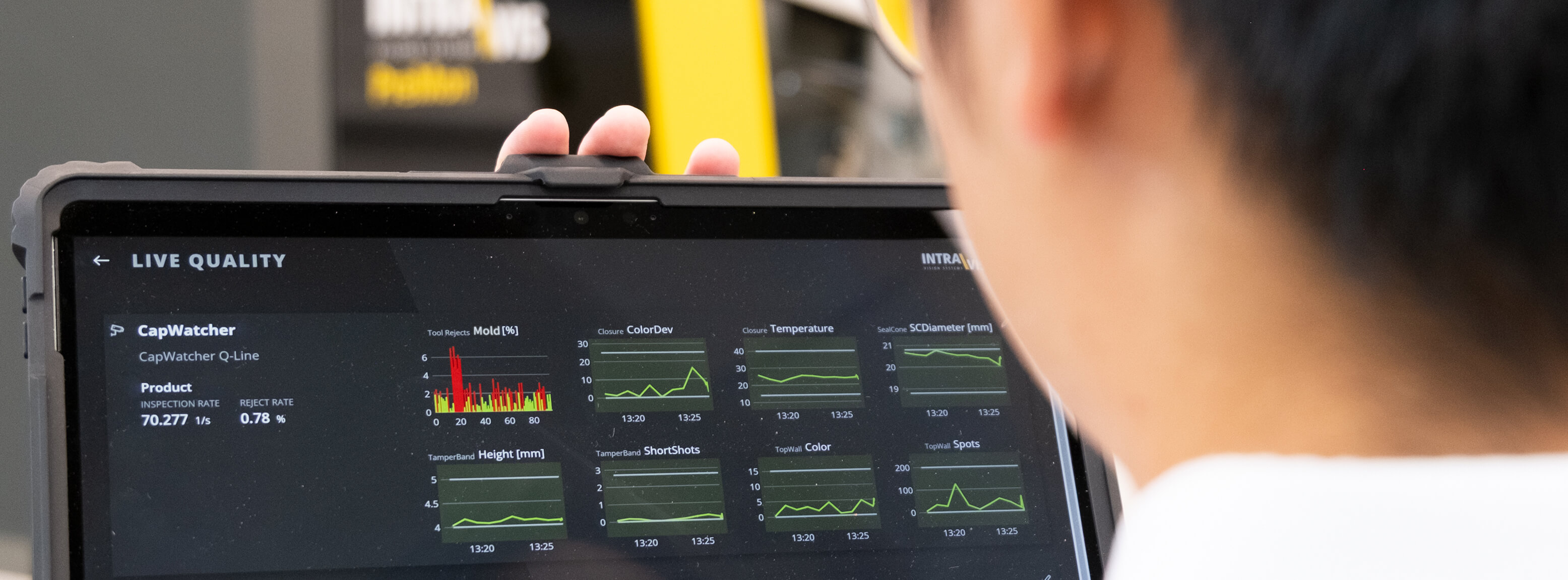
How IntraVisualizer improves efficiency, reduces scrap, and secures long‑term quality - A practical application at a closure manufacturer.
In high‑volume manufacturing, even small process deviations can have a significant impact on productivity, quality, and cost. At the same time, the increasing complexity of production processes makes it harder to identify root causes quickly and to make confident, data‑driven decisions.
One of the leading closure manufacturers in the world faced exactly these challenges in its production. By introducing IntraVisualizer as an analysis and visualization tool, the company was able to gain new transparency into its production processes, dramatically shorten decision cycles, reduce scrap, and establish a more sustainable approach to process control.
This article outlines key problem areas and shows how they were successfully addressed using IntraVisualizer.
Challenge 1: Slow Feedback Loops During Process Startup
Initial situation:
During injection molding startup and process validation, dimensional deviations were often detected only hours after adjustments had been made. Measurements were carried out externally, and feedback was delayed. As a result, technicians had to repeat corrections multiple times before reaching a stable, approved process.
This extended validation phase tied up machines, people, and material - and delayed production start.
Solution with IntraVisualizer
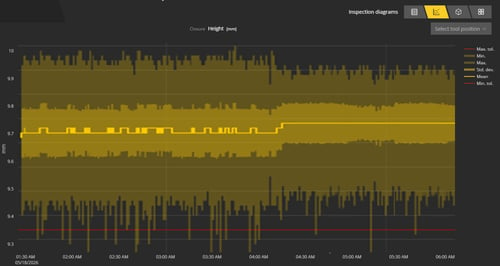 With IntraVisualizer, dimensional data became available almost immediately and could be analyzed live. Instead of waiting for delayed measurement results, technicians were able to monitor how dimensions reacted to process changes in real time.
Result:
- Multiple process settings could be evaluated within a short time window.
- The best-performing setup was identified based on objective data.
- Process validation time was reduced by several hours.
What had previously been a trial‑and‑error sequence became a structured, data‑driven decision process on the shop floor.
Challenge 2: Persistent Scrap Without a Clear Root Cause
Initial situation:
Over several months, the company observed a recurring rejection rate for a specific feature. The issue appeared across different colors, materials, and process settings. Various root causes were suspected, ranging from material behavior to parameter selection – but no clear correlation could be identified.
Process changes that improved dimensions sometimes led to higher rejection rates elsewhere, forcing operators to revert adjustments.
Insight through detailed data analysis
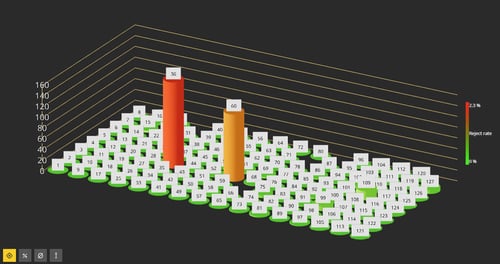 Using IntraVisualizer, quality data was analyzed in greater detail – broken down by cavities and individual features. This revealed a consistent pattern:
Specific cavities showed abnormally high rejection rates across multiple runs, regardless of other variables.
Corrective action:
After replacing the affected components, the company reduced the rejection rate for the critical feature to 0%.
The key advantage was precision: Instead of broad process changes, the team was able to take targeted, effective action based on clear evidence.
Conclusion: Data That Drives Measurable Improvement
In this application, IntraVisualizer delivered tangible benefits:
- Significantly reduced process evaluation and startup times
- Targeted reduction of scrap and rejection rates
- Improved process stability and product quality
- Greater confidence and transparency in decision‑making
Ultimately, better data leads to better decisions – and those decisions directly improve efficiency, reduce costs, and increase customer satisfaction.
For this closure manufacturer, IntraVisualizer has become an essential tool for sustainable, data‑driven process optimization.